Client Tracker + CRM | Templates Excel: Streamline Your Workflow
Simplifying Client Relationships Without the Overwhelm
If you've ever found yourself buried in sticky notes, scattered spreadsheets, or half-finished email threads trying to remember where a project stands, you know the frustration. Managing clients shouldn't require a degree in project management or expensive software subscriptions. That's exactly the problem the Client Tracker + CRM | Templates Excel toolkit was designed to solve.
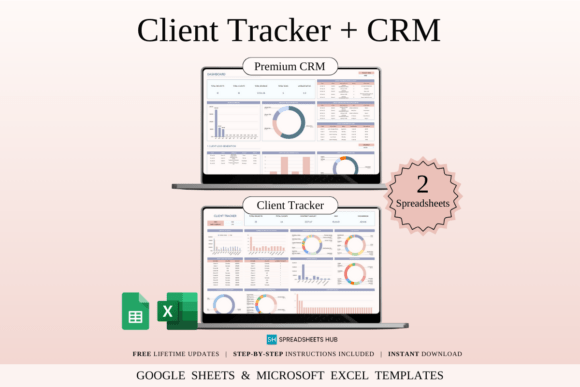
Think of it as a clean, well-organized digital notebook — one that actually works the way your brain does. Inside this toolkit, you'll find two purpose-built spreadsheets: a CRM Spreadsheet Template for managing contacts and communication, and a Client Tracker Spreadsheet for overseeing projects, timelines, and payments. Both are ready to open in Excel or Google Sheets, so there's no learning curve, no software to install, and no monthly fees eating into your budget.
What makes this particular setup stand out is its restraint. Rather than cramming every possible feature into an overwhelming dashboard, these templates focus on what actually matters — keeping your client information accessible, your project statuses visible, and your payment tracking honest. The layouts are clean, the navigation feels intuitive, and the built-in filters and dropdowns do the heavy lifting without requiring you to be a spreadsheet wizard.
Who Benefits Most from a Toolkit Like This
The honest answer? Almost anyone who works with clients and doesn't want to spend half their day managing the admin side of things. Freelancers juggling multiple projects at different stages will find the Client Tracker + CRM | Templates Excel especially useful for keeping everything straight. Coaches and consultants who need to track client progress over weeks or months can use the communication logs to maintain continuity. Service-based entrepreneurs — from graphic designers to virtual assistants to marketing strategists — can monitor their sales pipeline from the first conversation to final delivery.
I've seen too many talented professionals lose momentum because their back-end systems were a mess. You land a great client, but then you can't remember what you quoted them. You finish a project, but the invoice sits unsent for two weeks because you lost track of the timeline. These aren't dramatic failures — they're quiet, slow leaks in your business that add up over time.
This toolkit addresses those leaks directly. The CRM Spreadsheet Template gives you a centralized place for contact details, communication history, and where each lead or client sits in your pipeline. The Client Tracker Spreadsheet complements that by organizing project specifics — deadlines, deliverables, and payment statuses — so you can glance at your screen and know exactly what needs attention right now.
Design That Serves a Purpose
One thing I appreciate about these templates is that they don't try to be flashy. The design philosophy here mirrors what good modern typography practitioners preach: clarity first, decoration second. Just as a well-chosen sans serif font prioritizes readability over ornamentation, these spreadsheets prioritize function over visual complexity.
The color coding is subtle but effective. Dropdown menus reduce data entry errors. Filters let you slice your information by client, project stage, or payment status without building custom queries. It's the kind of thoughtful design that disappears into your workflow — which is exactly where it belongs.
For anyone who's built their brand identity around professionalism and reliability, having an organized client management system isn't optional. It's foundational. When you can respond to a client inquiry with accurate, up-to-date information in seconds rather than minutes, that communicates competence. When your invoicing is timely and your project tracking is transparent, that builds trust. These are the invisible design elements of your business — the ones that shape perception even when nobody's consciously paying attention.
Practical Applications Across Industries
Let's get specific about how different professionals might use the Client Tracker + CRM | Templates Excel in their daily work.
For freelancers and independent contractors: Use the CRM template to log every prospect who reaches out, tag them by service type, and track follow-up dates. Meanwhile, the client tracker keeps active projects organized with clear deadlines and payment milestones. No more scrolling through your inbox wondering if you sent that proposal.
For coaches and consultants: The communication log becomes a session history. You can note key topics from each call, track which package a client purchased, and monitor when renewal conversations should happen. It turns scattered notes into a cohesive client journey.
For creative professionals and agencies: Think of this as your lightweight project management layer. Even if you use more robust tools for design work itself — tools that handle typography, layout, and asset management — having a simple, visual overview of your client roster and active engagements helps you plan capacity and forecast revenue.
For small business owners and solopreneurs: If you're handling sales, delivery, and follow-up yourself, this toolkit becomes your second brain. It's especially valuable during busy seasons when details slip through the cracks.
Getting Started and Making It Your Own
Because these templates run in Excel and Google Sheets, customization is straightforward. You don't need special software or technical skills. Add columns that reflect your specific workflow. Rename fields to match your terminology. Adjust the dropdown options to align with your service categories or project types.
A few practical tips for getting the most out of the Client Tracker + CRM | Templates Excel:
- Commit to one system. The biggest mistake isn't choosing the wrong template — it's maintaining multiple half-finished systems. Pick this one, populate it, and make it your single source of truth.
- Update it in real time. A client tracker is only useful if it's current. Build the habit of logging interactions and updating statuses as they happen, not days later.
- Use the filters actively. Don't just enter data and forget about it. Set a weekly routine to filter by overdue payments, upcoming deadlines, or clients who haven't heard from you in a while.
- Back up your files. If you're using Google Sheets, this happens automatically. For Excel users, consider cloud storage to avoid losing critical business data.
The Bigger Picture: Systems That Support Growth
There's a temptation among creative professionals and entrepreneurs to dismiss administrative tools as boring or secondary. But here's what years of working with small businesses and brand identity projects has taught me: the businesses that scale sustainably are the ones with solid systems underneath.
Your client management process is as much a part of your design assets as your logo or your website. It shapes how clients experience working with you. A smooth, organized process signals that you're serious about your craft. A chaotic one — even if your actual work is brilliant — creates doubt.
The Client Tracker + CRM | Templates Excel toolkit won't transform your business overnight. But it will remove friction from the parts of your work that don't require creativity — the tracking, the organizing, the follow-up — so you can spend more energy on the parts that do. And in a world where everyone's competing for attention and trust, that kind of quiet operational excellence is a genuine advantage.
Whether you're a designer managing brand projects, a coach guiding clients through transformation, or an entrepreneur building something from scratch, having your client information organized and accessible changes how you show up every day. It's not about the spreadsheet itself — it's about what the spreadsheet makes possible.